Marine Science
Discoveries Expeditions Publications About
Menu
Discoveries Expeditions Publications About

Photo gallery

Maldives 2022

The Gaafu Arif Atoll is situated in the south of the Maldive Islands. Opposed to northern atolls, the stone corals of this area have recovered from a serious bleaching event in 2015. It is notable that in many areas, the diameter of living Acropora corals is 40 cm, equal to a growth of five to six years. Other areas in the atoll had amazing fields of long, bizarre colonies forming reef tracts devoid of other coral species and very poor in fish and other marine life. The molluscan fauna encountered had a moderately large amount of species but a remarkably low number of individuals. We went to Funamadua Island on two consecutive trips with two months inbetween.

All galleries

Funamadua Island, Gaafu Arif Atoll.
The flat reef top along the shore of Funamadua is a habitat which during half of the year is completely covered in sand. Severals ecies of Netitidae and Littorinidae manage to thrive here.
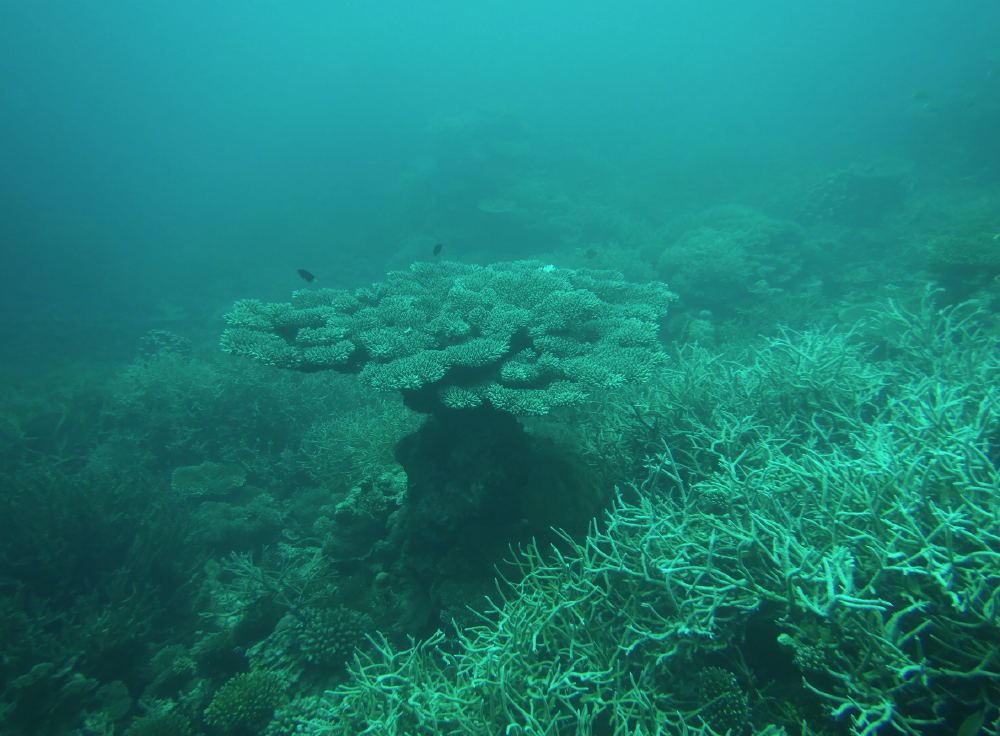
Large living coral colonies in deeper water. Note the near absence of fish!
Coral colonies of approximately the same size in the shallow water. This part of the reef had been completely eradicated by bleaching in 2015.
A larger colony of Acropora, a survivor of the coral bleaching event of 2015, with a smaller colony which apparently developed after the event.
Tridacna squamosa, one of approximately thirty individuals living in the shallow lagoon of Funamadua. All specimens are of an intermediate size or smaller, indicating a maximum age of four years.
Tridacna squamosa, dark mantle with vivid pattern formed by the symbiontic zooxanthellae.
Serpulorbis growing in a colony oc Acropora. In some areas, this filter feeding gastropod is abundant.
Darioconus ganensis is moderately common in shallow water.
A single individual of Talparia talpa was encountered several times on both trips, in the shallow lagoon of Funamadua. During the three months interval, it had moved approximately fifty meters from the place it was first spotted.
Chicoreus ramosus is abundant at depths not reached by local fishermen.
Mauritia histrio is not rare in the shallow lagoon. This subadult individual was observed on both trips. On the second encounter, it had just formed its characteristic net pattern.
Mauritia histrio, one of many adult specimens thriving in the lagoon of Funamadua.
Erronea caurica ssp. nov. This remarkable population from the Maldives has never been named. It is quite common in shallow water.
Another beautiful specimen of Erronea caurica ssp. nov.
Naria helvola was seen only on a few occasions, in a confined area of the lagoon.
Bistolida rubiginosa. This was an unexpected encounter in shallow water near the artificial island at Funamadua. These photos are the first showing the living animal.
Lambis lambis, well-camouflaged and quite abundant in shallow and deeper water.
Lambis lambis, the ventral side is beautifully orange and purple colored.
Monetaria caputserpentis is an abundant cowry found in wave-swepft areas of the lagoon edge. this single specimen was observed on both trips, in the same crevice of coral.
Terebra, mating couple
Jana taking pictures of the reef
Rachis punctata, a common landsnail encountered after rainfalls
Lissachatina fulica is introduced from Africa. In the Maldives, a rather small, slender and thin-shelled variation prevails.
←Galleries
marine-science.org
Contact · Imprint