Marine Science

Discoveries

This page shows a few of species we have discovered through our activities. They have been given a name in the meantime, or are currently studied by an expert who will choose a name for them.

Empressostrea kostini, discovered during the Spratly Islands expedition
Empressostrea kostini · Spratly Islands

Marine Science

When we search for shells in their habitats, we make sure not to cause any impact.

Usually, we try to gather shellgrit containing dead shells from beaches, the seafloor, or from crevices and caves. Usually, we do not take living specimens, unless absolutely necessary for their study.

Our activities are strictly compliant with the Washington Act (WA I & II), BAV, and local regulations for species protection, as well as the Nagoya Protocol. All holotypes have been donated to a public institution, usually the Museum national d'Histoire naturelle, Paris (MNHN), The Western Australian Museum, Perth (WAM), and the Molluscan Science Foundation, Inc., Maryland, USA (MSF).

Scientific collection · 360 records

Species index

A selection from the complete scientific collection.

Explore all 360 records

Marine Science

Discoveries

Empressostrea kostini

Empressostrea kostini Huber & Lorenz 2007.

The world's largest species of Oyster, new genus, new species,

discovered on our Spratly Islands tour in 2006. A peculiar, transparent pearl-fish (Onuxodon fowleri) lives inside this 60 cm long clam.

The fish had been known since 1955, but the host oyster could be described only 50 years later. After the publication of the scientific description, E. kostini was found also in Palau, the Philippines and many places in Indonesia.

Prosimnia hepcae

Prosimnia hepcae

Prosimnia hepcae Lorenz & Fehse 2011. A tiny (8 mm) parasite on soft corals, named in honour of the Hurghada Environmental Protection and Conservation Association. Since we started our activities in Egypt in 2008, we have discovered a dozen or more new species of molluscs in the vicinity of Hurghada, together with our team.

Simnia hiscocki

Simnia hiscocki

Simnia hiscocki Lorenz & Melaun 2011. First photographed by Keith Hiscock of Plymouth in England. This is a parasite to the soft coral Eunicella, which are sensitive to warm temperatures and hence vulnerable to parasites.

The tiny snail becomes increasingly abundant as an effect of climate change. It may serve as a bioindicator, but it had never been recognized as new species and was named only recently, in honour of its discoverer.

Read more
Conus hughmorrisoni

Conus hughmorrisoni

Conus hughmorrisoni Lorenz & Puillandre 2015. We were invited to join the Kavieng Biodiversity Expedition of the MNHN, Paris. New Ireland in Papua New Guinea had been a place we already conducted some studies with the help of our local friend Dietmar Amon.

This new species of Conus was discovered by Felix and could be added to the list of new taxa from the Kavieng area. Cone shells produce toxins that are in focus of medical research.

Morum lorenzi

Morum lorenzi

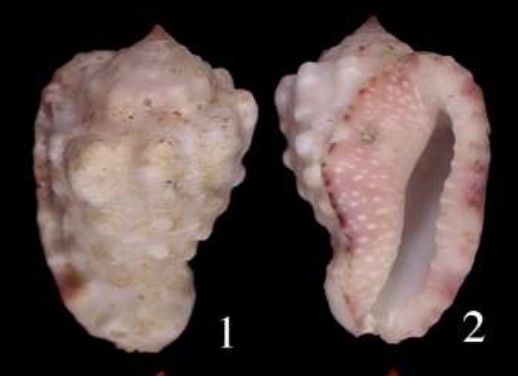
Morum lorenzi Monsecour 2011. Discovered on St Brandon Shoal in the Indian Ocean in 2011. This is the first species of Morum in the Indian Ocean with intracapsular development.

Shortly after its description, we discovered another species of this genus from the nearby Nazareth Bank: Morum inerme Lorenz 2014.

Tridacna lorenzi

Tridacna lorenzi

Tridacna lorenzi Monsecour 2015. Another discovery made on the hard to access St Brandon Shoal. It is an abundant species and valued food source for fishermen passing through the atoll, but it had never been recognized.

There are about a dozen species of Tridacna (Giant Clams) worldwide, and all, including this new one, are protected by law.

Recent discoveries associated with Dietmar Amon

Sometimes we meet other divers and shell-collectors who get infected by our enthusiasm.

A good example is Dietmar Amon, an avid naturalist and collaborator since more than ten years.

The Lissenung Island Resort has become famous in malacological circles because a considerable number of new species were discovered by Dietmar. His main method of collecting is gathering shell-grit from the floor of caves.

This grit represents a full spectrum of which species of seashell lived in the place the grit was taken from. Many new species are discovered by this ecologically sound method.

Dietmar's more recent discoveries, made by dredging on sand at 150-220 m depth, include Phasmoconus amoni and Cyllene chelonia (both Lorenz 2023).

Marine Science

Recent discoveries in the Maldives

Turritella janae

Turritella janae

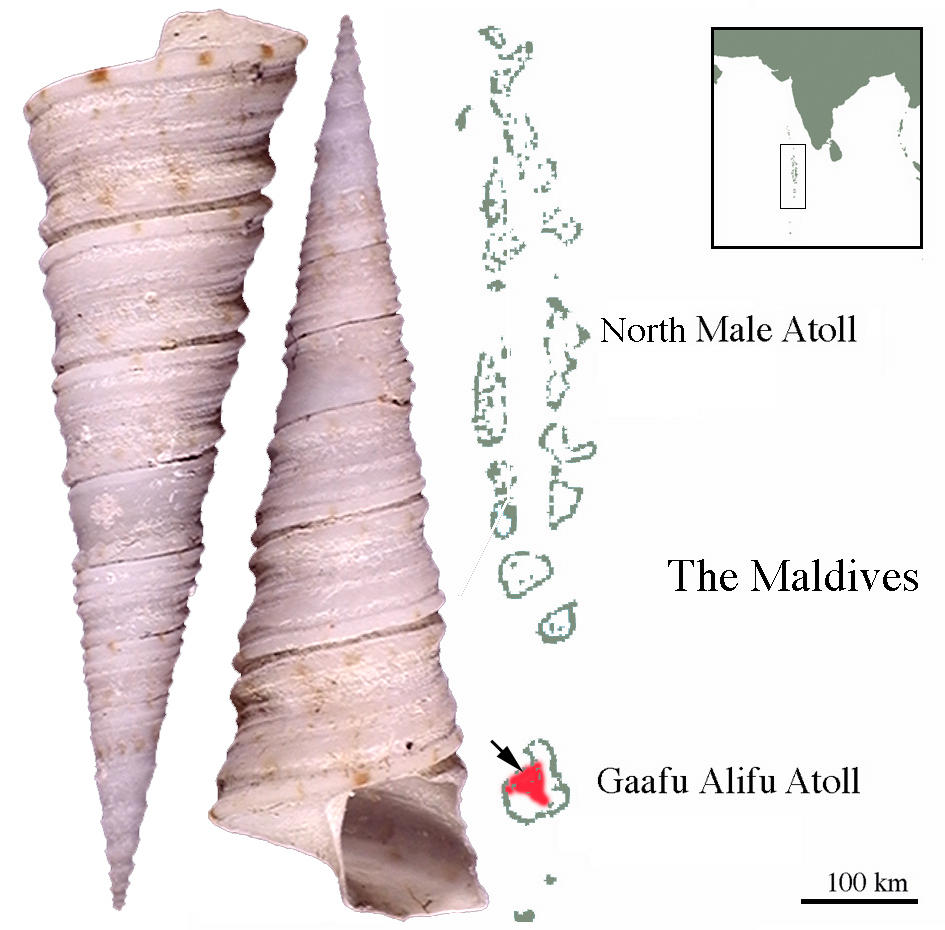
Who knew that the Maldives would still yield new species of Gastropods you can see with the bare eye. The distinctive Turritella janae Lorenz, 2024 is abundant in the Gaafu Alifu Atoll, where it thrives on sandy drop offs at 10 to 25 meters.

Its anatomy and life cycle could be thoroughly studied and it turns out to be a remarkable species completely overlooked by thousands of divers...

So far, we have discovered and named five new taxa from the Maldives.

Archivolva cheripoda

Archivolva cheripoda

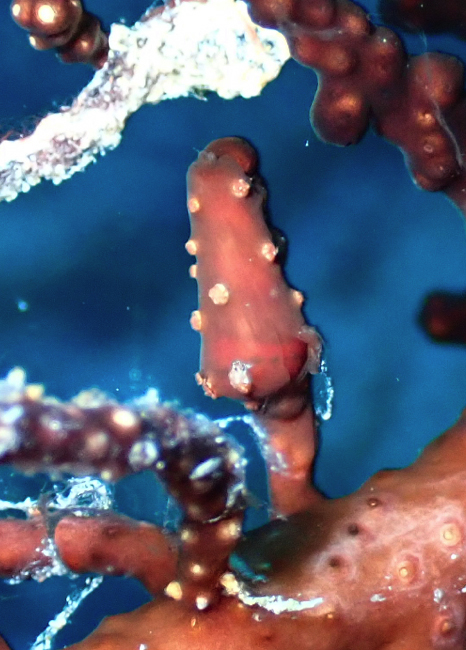
This is Archivolva cheripoda Lorenz, 2024, a tiny species of Ovulidae living parasitic on Siphonogorgia. It is the only species of Archivolva in the Indian Ocean and was discovered in 2023 in the North Male Atoll, but has also been found in Gaafu Alifu since.

It possesses an organ hitherto unknown in Gastropods: an extendible hand-like structure at the anterior part of the foot, allowing the animal to reach about. It was called the "cheripodium".