Marine Science

About Marine Science

Our main goal is assessing molluscan diversity of habitats, the discovery of new species of seashells, to involve amateurs and professionals in our research, in educating others, and in joining forces towards habitat protection and conservation.

Our mission

Assessing molluscan diversity of habitats.

What is the purpose of finding new species? First of all, it increases our knowledge of what lives out there. In assembling collections of seashells from different places, we provide an overview to the molluscan fauna that also characterizes a place in general: the combination of molluscan species of a particular location give indications on water temperature, bottom structure, other organisms that live in the same habitat, and also, if the environment is healthy or not.

The comparison of shell collections made over decades in the same place, as well as sampling dead shells from older sediment, can give information on the history of an area. Changes in the composition of the fauna, e.g. as an effect of pollution, dynamite fishing, or climate change, instantly manifest in a change in the molluscan fauna. The more we know about the shells of a particular habitat, the more such information can be obtained. Seashells can serve as source of information that could otherwise be gathered only by expensive and hard to conduct long-term analysis. They are the only marine organisms whose shells last for centuries and can be found in every marine habitat.

You can only protect a creature that is known to exist.

Taxonomy

From discovery to a scientific name.

Every species of plant or animal is given a latin name to assist communication among scientists. This name consists of a genus- and a species designation. A third name is given for subspecies, which are units within a species characterized by subtle differences within a defined geographical range. The name of a species is provided by a description which has to follow a certain procedure set by the International Code of Zoological Nomenclature (ICZN). The complete citation of a scientific name also adds the name of the author and the date of publication.

The discovery of a new species of shell requires the knowledge of what is already known and described. For many groups of molluscs, there are experts that are familiar with all described species in their respective field of expertise. When hunting for new species, it is necessary to involve these experts as no one can possibly have enough of an overview of all the tens of thousands of species of molluscs.

When a new species is discovered, the process of describing it can last between a few months and many years until the description gets written and published. After the day of the publication, the new species will be called by the latin name proposed by the author(s).

When we travel in search of new species, we make collections of nearly every group of shells, concentrating on those that look unfamiliar. These will be passed on to the respective experts worldwide. In the past fifteen years, we have discovered a large amount of fascinating new species from all over the world, including the world's largest species of the family of oysters, and a new species of Giant Clam, which are shown in the Gallery of Discoveries.

People

Field work, taxonomy and underwater photography.

Together with a team of divers and shell-enthusiasts worldwide, Jana and Felix organize trips to remote places of the world, in search of new malacological discoveries.

Both are keen scuba-divers. They have become renowed for their enthusiasm and efficiency in contributing to the knowledge of molluscan diversity.

Dr. Felix Lorenz

studied Biology and worked as scientific consultant and custodian at the University of Giessen. He lectured on systematic zoology, parasitology, and electron microscopy, as well as conducting research in various fields of Biology. Frustrated with the structures of public institutions and the modern approaches to mainstream science, he decided to quit his job to become an independent biodiversity researcher and hunter for new species.

He has published numerous scientific papers and books on cowries (Cypraeidae), ovulidae and other molluscan families, focusing on their systematic taxonomy, ecology and zoogeography. He has discovered and named more than 200 molluscan taxa. He also works as scientific consultant of the Molluscan Science Foundation, Inc. in Maryland, USA, and is an accredited appraiser for shell collections.

Jana Kratzsch

also studied Biology at the University of Giessen and became interested in diving and underwater photography in her early youth. She has become an experienced field worker involved in the search and documentation of gastropods, and the tiny and hard-to-detect groups, in particular.

Jana has contributed a large number of photos to “The Living Ovulidae” (Lorenz & Fehse 2009), and has become well-known for her in-situ photographs of seashells published in various books, e.g. those of Helmut Debelius.

Felix Lorenz and Jana Kratzsch during field work
Field work photograph

Marine Science

Collaborators

Institutions and non-profit organizations we collaborate with.

Field notes

News

Trips, publications, discoveries and project updates from Marine Science.

2019–2025

Recent news

DateUpdate
February 2025A trip to Yucatan together with our friends from the Molluscan Science Foundation. We practised some non-invasive collecting methods and discovered a spectacular new species of Olividae, in the center of the most busy and touristy place we have ever seen.
January 2025Finally, the release of the Cowries-book by Marco Chiapponi. It has been a long process, but the result speaks for itself and the reception among cowry enthusiasts is overwhelming.
October 2024Cyprus, an island we had in mind for a long time. The conditions were great, we re-discovered a "lost" species of Conidae, currently under study...
March 2024Another trip to the Maldives, the classic locality for seashells, Helengeli. The pumping of sand and massive construction activities have destroyed the ecology of that island.
February 2024Taghazout, Morocco in search of interesting shell-grit, finally found in a small area with very heavy surf. Many potentially new species, stuff for future research.
December 2023The IUCN workshop for the red list re-assessment of the Conidae was held at the Senckenberg Museum Frankfurt. Felix participated to evaluate the status of the more than 1000 species, together with other experts from all over the world.
April and November 2023More trips to the Maldives (five in total since '22) we discovered two new species (Turritella janae and Archivolva cheripoda), and identified a new organ in Gastropods, the cheripodium, a hand-like structure at the frontend of the foot.
November 2023Release of the MSF book "Carrier Shells - Garbage Collectors of the Oceans",written by Kurt Kreipl and Felix Lorenz. It features the gastropod family Xenophoridae that attaches foreign objects to their shells, human waste included.
February 2023Fuerteventura. For something completely different, we went to this drab island to do some intertidal sampling for the collection of the MSF. We collected 66 species of seashells, all empty but in nice condition, on beaches and in tidal pools.
October 2022Maldives again, same spot, as our work could not be completed, and we really like the place and have met lovely people.
July 2022Maldives... While Jana had seen the beauty of the reefs in the early 1990s, Felix never went. The goal is to study the shallow water faunaof the southern part.
March 2022We will meet our friends Eric and Maryse Le Court de Billot, to visit Rodrigues Island and examine the shellow lagoon waters and the shellgrit along the beaches.
March 2022The Molluscan Science Foundation now exists for 10 years!! We have come a long way, and achieved a lot. Check it out!
October 2021At last we could get out again, for a three week's trip to the Seychelles. The main target was verifying the existence of several cowry species that had not been found any more in recent years. We found all of them, and the reefs in better shape than on our 2017 trip.
August 2021Two new species of cowries are described in the Conchylia magazine No. 52(1-2): Erronea corona and Erronea amralii, latter honoring the late Amr Ali, director of HEPCA.
November 2020A long-awaited book was launched The Silvano Larini Cowry Collection. F. Lorenz - A portrait of an outstanding collection assembled by an outstanding personality. ConchBooks.
April 2020The book "Seashells from Rólas, São Tomé. F. Lorenz and J. Kratzsch - A handbook to the molluscan fauna of Rólas at the southern tip of São Tomé. ConchBooks was launched. It is already out of print. You can download a pdf here.
January 2020Sao Tomé, and the small island of Rolas in particular, turned out interesting for a variety of species, including a new Cerithium, which is abundant, but had never been named (now Cerithium lorenzi Bozzetti 2020). We decided to write a book about the place.
Sept. 2019An exhaustive trip to Kwa-Zulu Natal, surveying the Sodwana Bay area (several new species were discovered) and the northern Transkei. Lots of exciting dives, a lot of material still in the progress of being studied.
March 2019We went to the coast of Morocco to survey the occurrence of Schilderia achatidea, which turned out quite rare but otherwise typical for the West african coast.
January 2019We have started a Facebook group called Marine Conservation where people can post all sorts of pictures and movies to do with threats of the seas.

Archive

2018 field notes

DateUpdate
January 2018We went to Mirbat and the Hallaniyat Islands in Oman, on board the Oman Aggressor, together with Wayne Hasson. We discovered ten (!) new species of Marginellidae, one of which has been named Dentimargo aggressorum Cossignani & Lorenz 2018. At the Mirbat Marriott Hotel Beach, Felix noticed that the abundant shallow-water species commonly known under the name Colina pinguis did not really resemble the nominate South African taxon. Subsequent examination of the shells revealed a new species endemic to the area of Mirbat. It has been named Colina lorenzi Bozzetti 2018. We had not expected to find so many new species in the limited time we spent..!
March 2018The second Volume of the long-awaited Cowry book has been launched. A 7 years trip of compiling the 1400 pages in total has come to an end and there is time for new adventures.
April 2018Felix went to Baltimore to give talks to sponsors and affiliates of the Molluscan Science Foundation, Inc. Shortly after USA he went to Western Australia to attend an expedition using a remotely operated vessel commercially collecting shells. Many new species have been discovered by this venture in recent years.
May 2018We were invited by SUBEX and HEPCA to attend a biological symposium with diving and photography in the bay of Sahl Hasheesh in Egypt, hosted by Johann Vifian. We did a lot of diving and identified at least three new species of Turridae, one of which will be named after SUBEX. We then went on a private research trip on board our favorite Egyptian liveaboard, the MV Aeolus with our team of six. Hardly to believe, but we discovered a new species of Cowry, alas only a single fresh dead shell, yet so distinct that it will be named in the near future. Who knew...
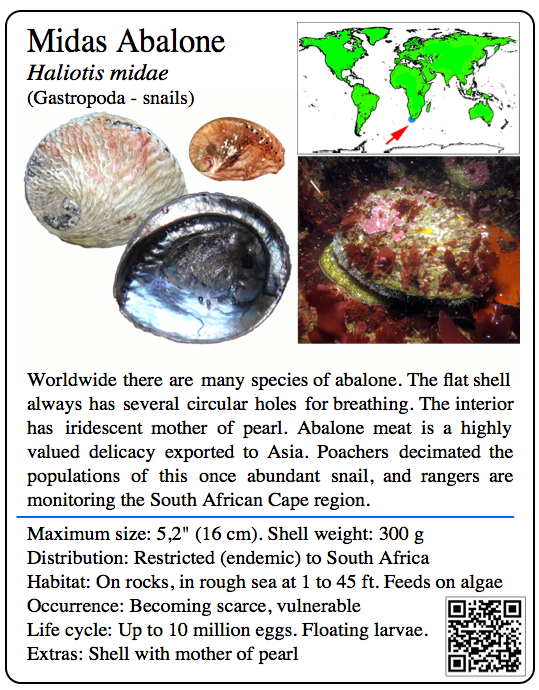
August 2018The School Project is entering the next level. Felix and Jana are busy editing the fact-cards. The idea of the school project is to put shells into the hands of 5-7 graders to trigger fascination and awareness - for many kids it will be the first time they can examine an item from living nature, sadly enough. Together with the Molluscan Science Foundation we will deliver posters, information for teachers and sets of readily available, dead-collected shells (approx. 20 species) plus fact-cards (see below samples) on a total of 40 selected species, and send them out to schools nationwide. The kids identify the shells they are given, do a show and tell with their classmates, scan the QR code for a link to additional information, movies, etc. In following lessons, the teacher will discuss the vulnerability of the habitats the shells live in, the necessity to preserve them, and how each of us can contribute to protect the mollusca and their environments, e.g. by reducing waste, and conserving ressources such as water and electricity. The test runs we have done with a rather basic setup in schools in the US and in Belgium are overwhelming.
November 2018To broaden our knowledge of the Caribbean, we went to Curaçao and Aruba. We left out Bonaire because a place where you are not allowed to even pick shells up from the beach is out of bounds for us. In Curaçao we hired the Curasub to look for shells to a depth of 300 m. We returned with rich material from the beaches of both islands, the intertidal zone and the upper sublittoral. A comprehensive report will soon be published in The Festivus magazine.
School project fact-card sample